
New Ulm, Brown County
Sara Ahrens has taught preschool in New Ulm for 27 years. She spends her days working with 4-year-olds on foundational elements of their educational career, like colors and shapes, in addition to social and emotional behavioral skills that will last a lifetime.
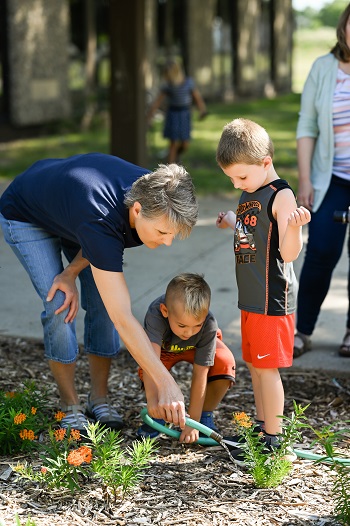
Sara Ahrens shows preschoolers how to water plants.
While Ahrens has nearly three decades of experience under her belt, she knows the importance of furthering her own education, and makes sure to take advantage of training opportunities when she can. Fortunately, she has not had to look hard to find those opportunities in her own backyard.
Local trainings, nationally renowned presenters
Southern Minnesota Initiative Foundation (SMIF) offers a wide variety of trainings to early childhood professionals in its 20-county region. The trainings run the gamut from an annual conference to smaller workshops, but all focus on providing quality care for children.
Ahrens attended SMIF’s Early Childhood Care Conference in 2019. The conference, which attracts more than 400 early childhood educators and child care providers to Owatonna each fall,* offers a full day of learning and networking. Breakout sessions cover topics including outdoor learning, working with children who have experienced trauma and partnering with parents in the classroom. “I wanted to attend everything at the conference,” said Ahrens. “The presenters and speakers are phenomenal and I got to meet teachers from other districts. I had never been to any training that had so many different aspects to it. It was just pretty amazing all around.”
For Ahrens, the highlight of the conference was the keynote speaker, Jackie Kops. Kops, who is based in Missouri, is known for her play-based learning activities that are easy for educators to implement in the classroom. She offers tips on how to set up classroom environments so that they are interactive and can integrate all learning domains. “I couldn’t believe SMIF was bringing Jackie Kops to the conference,” said Ahrens, who has been an avid follower of Kops’s classroom tips for years. “No way in a million years would I have thought I would see her in person.”
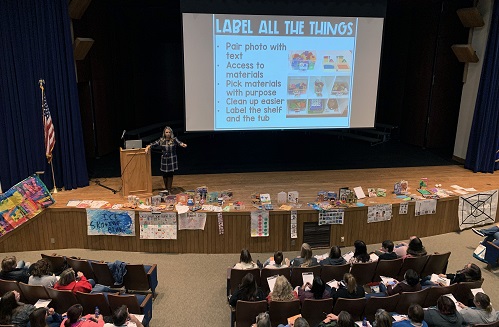
Keynote speaker, Jackie Kops, talks about implementing play-based learning activities in the classroom at the 2019 Early Childhood Care Conference.
Ahrens was able to easily implement several things she learned from the keynote presentation. “What I walked away with from her was something I could do right away in my classroom,” she said. Many early childhood educators have “dramatic play centers” where the children go in and work together to engage in conversation. The centers have different themes, like a pet shop or bakery. In Kops’s presentation, she explained how to extend children’s learning in these centers by bringing in a cross section of items from different areas of learning. For example, teachers can bring literature into a zoo-themed dramatic play center by introducing books about zoo animals, or they can incorporate math by including a snack shop with prices for food. “It’s changed the way I think about different areas in my classroom,” said Ahrens. “I’m more comprehensive with how I set up a dramatic play center. I don’t just have to have a writing center – some of my writing stuff can be in the dramatic play area.”
While this was Ahrens’s first time attending the conference, the New Ulm Public School District has had a relationship with SMIF for years. Betty Uehling, Director of Early Childhood and Family Education (ECFE) Programs for the district, explained that Brown County became one of the first Early Childhood Initiative (ECI) communities in 2006, a SMIF program which supports young children so that they have the best possible start toward a healthy life of learning. In 2013 the district also worked with SMIF to become a mentoring site for the S.M.A.R.T. program which teaches a series of movements that help children’s brains prepare for learning. “We received invaluable training and coaching through this program which enabled us to not only afford to have our whole staff trained in S.M.A.R.T. but the trainers mentored us to ensure we were implementing the program with fidelity,” said Uehling.
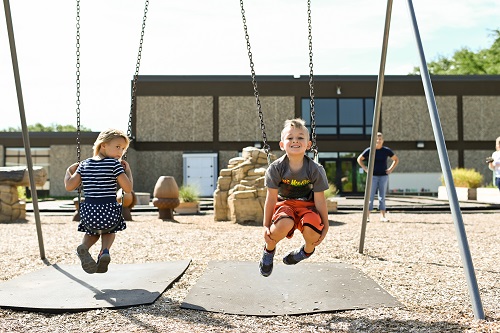
Children playing outside the New Ulm Early Childhood and Family Education building.
Because of the district’s background with SMIF, Uehling knew that the Early Childhood Care Conference would be extremely valuable for her staff. “SMIF has a history of bringing high quality, relevant trainings to our region at low or no cost,” said Uehling. At around $35 per person, a cost that is kept low thanks to generous sponsors, she was able to send five staff members. This is important to Uehling as staff trainings are often the first item to get cut when dealing with tight budgets. “A lot of us from Greater Minnesota are not able to get to the metro area conferences because we don’t have the program funds to pay those high registration fees, plus meals and hotel fees, which means I can’t send staff to trainings,” she said. “So SMIF doing what they do allows me to get the trainings for my staff that I would not otherwise be able to provide.”
Life-altering learning
For Ahrens, the real eye-opening training was a summer workshop she attended called Conscious Discipline™. SMIF first hosted this training in 2018, also in Owatonna. More than 300 attendees learned about different ways to help children through moments of conflict and difficulty by helping them develop the skills to regulate their behavior. The training was so popular that SMIF hosted it again in 2019 and offered two days for beginners and two days of an advanced course. Ahrens attended all four days.
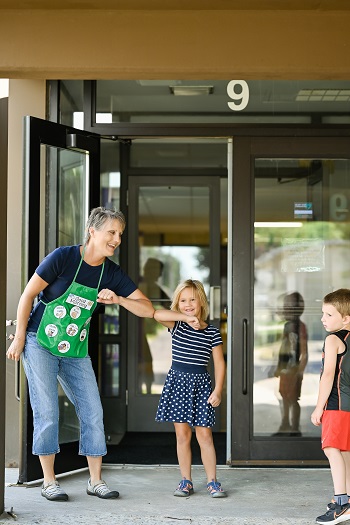
A preschooler greets Sara Ahrens by touching elbows after choosing from a variety of greeting options that are listed on Ahrens’s vest.
“The Conscious Discipline training was the best training that I’ve ever been to in my entire teaching career,” said Ahrens. “It changed my life. I think as educators we have been progressively expecting more and more out of these kids to act like adults, versus giving them skill sets that they can use for life.” She explains that Conscious Discipline is about moving away from telling children to solve a problem in the moment, and instead gives them the skills that will help them solve many problems.
One of the ideas that she implemented right away in her classroom was a “greeter vest,” which helps her connect with her class on a more authentic, personal level. In the morning she wears a vest that has pictures on it with different options for how the kids could be greeted – a handshake, a fist bump, a wave or a hug. “It helped me connect much faster with my kids at the beginning of the year,” she said. “It was a way for me to know I had connected with every child and smiled at them every day. Sometimes you get lost in the hustle but this made me stop and acknowledge every single child when they came in.” The greeting ritual also gives her children a sense of safety and connection, and helps start the day with a sense of cooperation and caring.
She knew the benefits of her training were being infused in the classroom when she saw a little boy calm himself down after getting upset while playing with other kids outside. She had previously taught her class how to do “balloon breathing” by using a balloon to explain how to breathe slowly and deeply so that it expands the stomach instead of fast breaths that stay in the chest. This type of breathing brings in more oxygen which helps alleviate stress or anxiety. “What I found amazing was that the little boy was upset on the playground and I said, ‘breathe with me’ and we took three deep breaths together and immediately his whole body calmed,” said Ahrens. “Sometimes with kids the adults have to be the calming presence, but this kid was able to calm himself and internalize the concept of ‘breathe with me’ that we had learned earlier.”
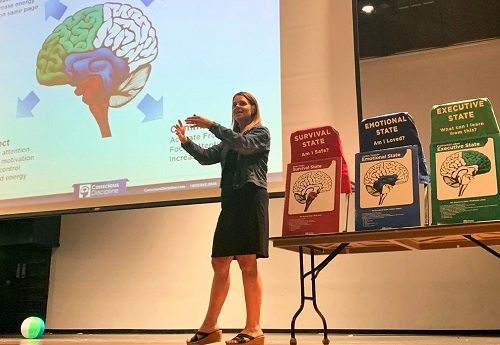
Anne Hoff speaks at the 2019 Conscious Discipline training.
Ahrens also feels she is more conscious in the classroom now. “The training helped me ask where the behavior is coming from,” she said. “In the past I would redirect them somewhere else instead of finding out why the behavior is happening in the first place.” It has also allowed her to instill important life skills without having to involve the parents. “You can teach Conscious Discipline in your classroom and it can change that child’s life without having to have the parents teach it too,” she said. “I think that is what every educator is looking for. It allows us to not blame the children or parents for behavior – we’re just teaching a skill set that they can use for life.”
Ahrens’s hope is that eventually the rest of the teachers in the school will be using Conscious Discipline in their classrooms as well. She and another teacher who attended the training put up signs around the building to show everyone how to do the breathing techniques. “Even if people were not at the training, everyone is aware of it,” she said. Uehling, who also attended the training, has supported sharing the highlights with other staff. “We are now sharing Conscious Discipline with all the preschool and kindergarten staff in our building in order to create an atmosphere where we fully understand that children must feel safe in order to learn and grow,” she said. “This training provided the foundation for all other social emotional curriculums to build off of – it was the piece we were missing.”
Quality trainings for quality care
While many of SMIF’s trainings are attended by early childhood educators like Ahrens, they also attract many child care providers. Greater Minnesota has been experiencing a child care shortage for years, so one of the goals of these trainings is to ensure that current providers stay in the child care field. Family-based child care is a challenging, labor-intensive field that requires licensure and ongoing training and long hours. It demands child development and business skills, and the compensation is typically low. SMIF’s Early Childhood Trainings give providers an opportunity to earn training credit, learn new strategies to implement in their own programs and connect with other providers in their area to widen their understanding of best practices in child care.
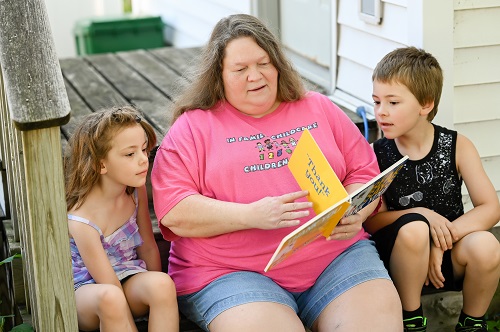
Mary Swanson reads to children outside her home-based child care business.
Mary Swanson, who has managed her home-based Maree’s Merry Makers Child Care for 35 years, attended SMIF’s Quality Child Care Program (QCCP) training in April of 2019 when it came to New Ulm. Like Ahrens, Swanson is always looking for ways to further her education, which enriches her decades of experience. Swanson likes to talk about how children absorb everything. “When they’re infants, they can’t talk, but they are like sponges,” she said. “I’m always learning too. I’m like a sponge myself.” Swanson was one of 17 child care providers who attended the program in New Ulm, which is where her business is located.
QCCP started in 2013 as an opportunity for child care providers to increase the quality of their business. Two partners, First Children’s Finance and Families First of Minnesota, Child Care Aware Southern, spoke to providers about ways to advertise their business, enforcing policies and procedures, finding new revenue streams and more. To make it more accessible for providers, the program was held for two hours in the evenings in different parts of the region. Since the start of the program nearly 50 QCCP events were held in southern Minnesota communities. SMIF now holds many high-quality professional development sessions under the umbrella title, Early Childhood Trainings, which take providers and educators into new and deeper topics and offers more variety and action steps for them to incorporate into their work.
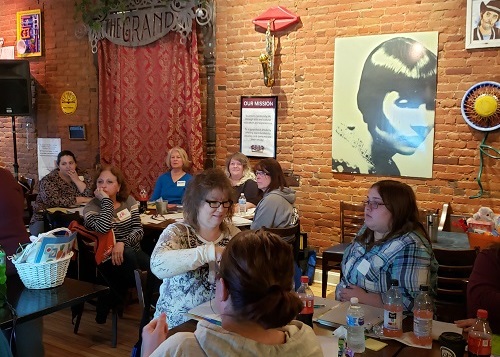
Mary Swanson and other child care providers attend an Early Childhood Training in New Ulm in 2019.
During the session the providers participated in a self-reflection and goal-setting exercise which helped them envision what they wanted their business to look like in five years. This gave Swanson the courage to do some new things for her own well-being, which she had previously been hesitant to do. “Now I’m not afraid to ask for some time off,” she said. “I take the last Friday of the month off and call it a ‘refresh day.’ Before that I thought, the parents have to work, I can’t do this. But now I think, I can do this – I don’t take a vacation but I can take a refresh day. And the parents understand.” She said she also came away from the training with the courage to raise her rates. “I learned to not be afraid of doing this,” she said. “I did raise my rates, and I did not lose families like I thought I was going to.”
Another goal of many of the Early Childhood Trainings is to encourage providers to become Parent Aware-rated, Minnesota’s quality rating and improvement system which offers tools and resources to help providers improve their practices and to help families find quality care. Swanson had previously known about Parent Aware, but participating in the training is what ultimately motivated her to connect with them and go through their Building Quality program. She learned about different ways to incorporate play with science, art, diversity and other educational topics. She also learned about enhancing her observational skills. “Parent Aware worked with me to better observe how the children were developing and figure out what I needed to do to help them develop more,” she said. Swanson is one of more than 700 child care providers who have attended SMIF’s training, 33 percent of whom have ended up in Parent Aware.
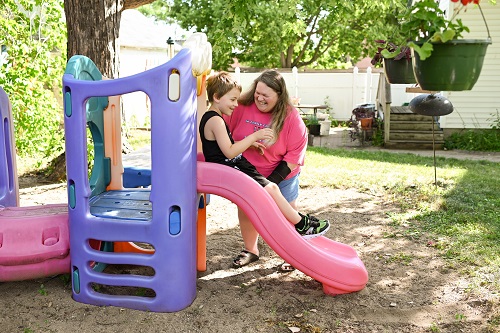
A boy plays outside Maree’s Merry Makers Child Care.
Not only was the session held in her own community, but Swanson thought the price and added incentives made it very accessible. “The cost was $20 but when we showed up, we got a $20 gift certificate,” she said. “We were also offered an additional eight hour training for free, which we didn’t know about until we got to the class.” Many of SMIF’s Early Childhood Trainings allow participants to receive “DEVELOP” credits, which is a Minnesota-wide system for early childhood professional development. Earning credits builds quality towards their licensing, so the opportunity to have a local option for trainings is important for providers and educators.
Swanson was also excited to receive a tote bag with free books from the event. “So many people buy toys for the kids, but I buy books for the kids,” she said. “I have a collection of over 3,200 books and I rotate them depending on the season or different things we are working on.” In June they usually read about birds and butterflies. The books she received at the training included Doggy Pants, Pink, and Rectangles, all from ABDO Publishing. SMIF partners with Mankato-based publishers ABDO and Capstone to distribute thousands of books to children throughout the region each year to support early literacy efforts. Swanson is looking forward to putting these books into the hands of children in her care. “I have two kids who are going to school this fall, so I am going to give them the bags with the books as a sendoff and thank you for being here.”
Bringing it full circle
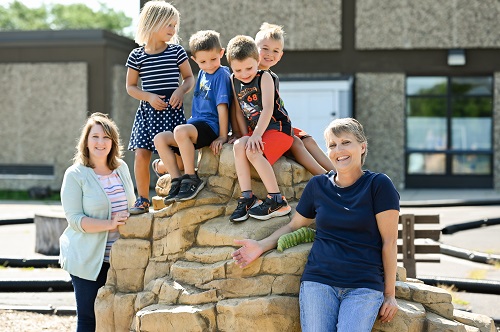
Betty Uehling and Sara Ahrens with children outside the ECFE building.
In addition to the trainings that SMIF offers directly to early childhood professionals, Uehling said that SMIF has also supported the New Ulm School District in tailoring their own trainings for child care providers in Brown County. In 2015 the School District received a SMIF Early Childhood Grant to offer a program called ECFE on the Go. “A licensed early childhood teacher visits child care programs in the county to read stories, sing songs, and to model how to use new learning materials that the providers are then able to keep for their program,” said Uehling. “The grants have also enabled us to bring high quality presenters to our county, allowing providers to not only attend free of charge, but without having to travel long distances after a long day of caring for children.”
Swanson was one of the child care providers who signed up for the ECFE on the Go program. Ahrens, along with another teacher, came to her home multiple times throughout the summer to teach the children sign language, songs about how to introduce yourself and information on different emotions. “I wish it could have gone all summer instead of just the four times,” said Swanson. She was excited to be given more books through this program. “Sara would read the book, and I would read it, and then I would find the kids sitting down with their dolls and the babies and reading these books to them,” said Swanson. “I’m not sure that they knew the words, but because there were so few on a page, they would pick it up after a few times of hearing it – it was so awesome to watch how they were developing with just a few repetitions.”
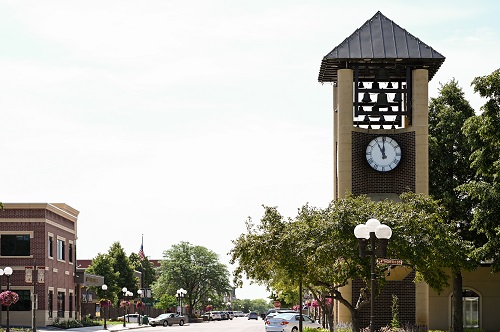
Downtown New Ulm.
Uehling pointed out that a lot of the same educators who are attending SMIF’s trainings are taking what they learned and then bringing it back to the providers. “When they are interreacting with the students and showing them how to do yoga and breathing techniques, this goes back to the Conscious Discipline training, so we are bringing this information full circle,” she said. “The providers are so appreciative of us being able to do that, which we wouldn’t be able to do without the funds from SMIF.”
A commitment to continuing education
Both Swanson and Ahrens are grateful for the opportunities to keep learning and developing as early childhood professionals. “It wouldn’t have been possible if SMIF didn’t cover it,” said Ahrens. “That’s how I feel about all of it. The trainings that SMIF does – you can’t wait to go, you’re so excited because there are so many good presenters there.”
Bringing these trainings directly to southern Minnesota educators and providers not only help them build quality into their business or classroom, but they discover new ways of doing things. “Had SMIF not offered it, I probably would have never known about Conscious Discipline,” said Ahrens. This keeps their skills sharp and allows them to better serve the children they are committed to working with every day.
For more information about SMIF’s Early Childhood Trainings visit smifoundation.org/ectrainings.
This story is from SMIF’s 2020 Impact Report. To read the other stories from the report, and to view maps showing the impact of these programs, visit smifoundation.org/impactreport.
*Due to the limitations of planning during the pandemic, SMIF is providing ongoing professional development opportunities to early childhood professionals in place of the annual Early Childhood Care Conference in 2020. We expect the conference to return in 2021 and look forward to highlighting more great trainers and content.