
This story is from the 2021 FEAST! Magazine.
Consider a jar of local honey at the farmers’ market. Golden and sweet, it tastes like sunshine, and buying it supports your farmer-neighbor. But what does it take to get that amber treasure from the bees to your pantry? An entire ecosystem…and not just the environmental one.
The Local Food Ecosystem
Behind every local product lies an entire local-food ecosystem. From farmers and foodmakers to farmers’ market organizers and business advisors, it takes a host of behind-the-scenes participants to help that local honey producer succeed, especially with stiff competition from cheaper industrial versions.
 One such group is the FEAST! Local Foods Network, a collective of nonprofits, agencies, entities and individuals. The FEAST! Network provides resources and support for local farmers, foodmakers and their communities to build thriving rural economies where all who dream of making and eating local food can.
The Network has helped hundreds of farm and food businesses since it formed in 2013 but there’s still much to do. That’s why four of its members—Southern Minnesota Initiative Foundation (SMIF), Renewing the Countryside, Minnesota Farmers’ Markets Association and Sustainable Farming Association—launched a three-year initiative called The Local Food Sustainability Project, the goal of which is to learn as much as possible about the issues facing local farmers, foodmakers and farmers’ markets. Through interviews, farm and business visits, an advisory council and other sources, the project is gathering information to develop strategies for strengthening and supporting the local food system for years to come.
“With this project, we are working to create a culture of data collection among farmers’ markets and small to mid-sized farmers in Minnesota,” said Kathy Zeman, Executive Director of Minnesota Farmers’ Markets Assoc. (MFMA), one of the Network’s nonprofit partners. “We need as much information as possible. Through this and other projects, we will collect important information, work to understand it, and use it to better support and strengthen our growers, producers and farmers’ markets.”
The project’s goals also include bolstering infrastructure to “build capacity of an ecosystem that will support farm and food entrepreneurs,” adds Jan Joannides, Executive Director of Renewing the Countryside, a Minnesota nonprofit and Network co-founder. “That is what the FEAST! Network started out to do—and we’ve been doing it well—but this project will help us accelerate the work. The Project is also helping us connect with underserved farmers and food entrepreneurs to help us better reach and support those businesses owners.”
AmeriCorps VISTA
With massive amounts of information to collect, organize and analyze, the Network needed help. Enter AmeriCorps VISTA (Volunteers in Service to America). AmeriCorps is the federal agency connecting individuals and organizations through service and volunteering to tackle the nation’s most pressing challenges. Since 1965, more than 220,000 AmeriCorps members in the VISTA program have helped local organizations expand their capacity to make change.
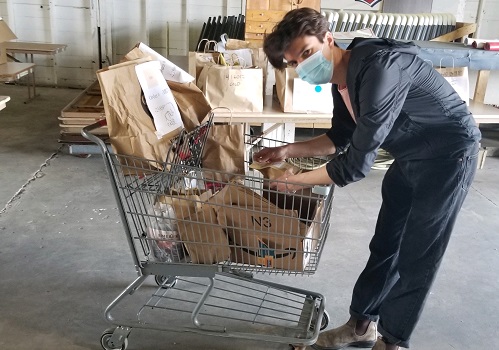
2020 – 2021 AmeriCorps VISTA member, James Harren, helps during the FEAST! Online Marketplace curbside pickup in 2021.
James Harren joined the Network from AmeriCorps in November 2020 as its first Local Economic Opportunity VISTA. “I’m excited about the work I’m doing and food system work generally. It’s the strongest way to strengthen rural communities,” says James, a Chicago native. His VISTA work is hosted by SMIF, a Minnesota nonprofit and Network co-founder. “There is so much joy and community in sharing a meal and that is made even stronger when you know who grew or raised your food. Food brings us together, and if the people who make food are uplifted, we can flourish together.”
In 2021, Maeve Mallozzi-Kelley, another AmeriCorps volunteer hosted by SMIF, joined James on the project as the Farmers’ Market Economic Opportunity VISTA. Maeve works on the farmers’ market side, gathering information from market managers, vendors and customers throughout the 20 counties in southern Minnesota covered by the project. She hopes to get a sense of the organizational and financial structure of farmers’ markets, diversity in food access programs, and the impact of food licensing and ability to sell at other markets on local entrepreneurs. Customer surveys will also provide insight into how many people visit markets each day, how much is spent and if the hours and location are convenient.
“I am excited about the opportunity to have a direct, positive impact on our local food systems,” she says. “This work touches every aspect of our foodsheds, from growing and selling to accessibility, consumption and community health. I hope the work I am able to do this year will prove the importance of small farms and data collection so this work can be expanded to the rest of the state and continue to support small and emerging farmers for years to come.”
Room for growth
During the summer of 2021, both James and Maeve crisscrossed southern Minnesota, meeting dozens of farmers and food producers to determine gaps in support. James also formed the Local Producers Advisory Committee to gain insights from local entrepreneurs like Kim Olson, owner of Grandma’s Gourmets in Albert Lea, Minn.
“This project is very important for growing the local economy,” says Kim, who serves on the Advisory Committee. “It’s critical to identify the areas where farmers and producers need more support and resources, and to find more ways to get those two groups together. As a business owner, I am always looking for resources that will help my business grow. This project will hopefully make it easier for food and farming entrepreneurs to access those resources.”
The project is still in its early phase, but the important work of gathering information is critical to laying the groundwork for removing barriers, fostering a culturally diverse food system, and helping local food producers and makers build sustainable businesses. It is already abundantly clear that this project has the potential to strengthen the local food system long into the future.
If you’re interested in participating in the Local Foods Sustainability Project, contact SMIF at (507) 455-3215, inquiry@smifoundation.org.
Featured image: Open Hands Farm in Northfield.
Note: Since this story was written, James Harren has completed his service term through AmeriCorps VISTA. We are currently seeking applications for this position to continue this project. Apply here.