
Erin Dorbin was living in Rochester and working for the Preservation Alliance of Minnesota when she had to drive through Houston County for a meeting. She immediately fell in love with the characteristic hills and valleys of southeastern Minnesota’s Driftless Region and knew she had found her future home. A native of a small township in Michigan, rural life has always been an important part of her identity.
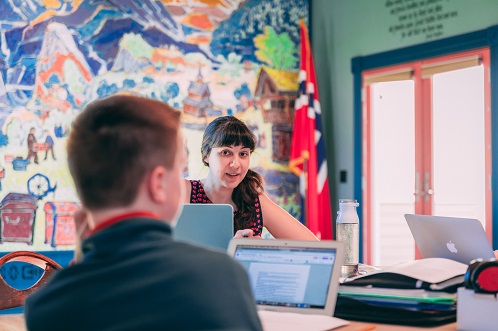
Erin Dorbin works with a student on the Stories: YES Houston project. Photo credit: Kollective Photography
Dorbin started dipping her toes into rural arts and cultural development in Minnesota by joining the Board of Directors at Lanesboro Arts, and was inspired by how the organization was able to activate the town of 732 through different arts initiatives. She eventually put down roots in the region by moving to the neighboring town of Houston which has similarly small population of 979. “I felt an overwhelming sense of potential and opportunity in Houston,” said Dorbin. From the local coffee shop to the Houston County Economic Development Authority, she discovered a community that was rich with creative, open-minded people. She wanted to ignite that same sense of action and excitement for creative community projects that she experienced in neighboring Lanesboro.
One of the primary ways she was able to rally local excitement around a community initiative in Houston was developing a project called Stories: YES Houston, in partnership with Smithsonian’s Traveling Exhibition Service, Museums on Main Street (MoMs). (The “YES” stands for Youth + Engagement + Storytelling.) As a multimedia historian and educator, Dorbin designed the program to encourage young people to investigate, create, and sustain their rural identities through local history research and digital storytelling. “I found that it was very easy to collaborate and get support,” she said. Houston was selected as one of only six communities in the U.S. to participate in this program developed by the Smithsonian. In Houston, the goal was to have students ages 13 – 18 interview locals and produce compelling multimedia stories detailing the local economy and worker identity. While the community was ecstatic to be selected for this project, they needed additional funds to make it a reality.
In 2018, Dorbin partnered with the City of Houston to apply for a $10,000 Small Town Grant from Southern Minnesota Initiative Foundation (SMIF) to support this project. The grant, which seeks to build sustainable and vibrant communities, helped fund materials and supplies to bring the students’ research to life in the form of audio and video documentaries, and detailed story maps. “SMIF helped me put those pieces in motion and got students’ community stories out there,” she said. It also supported the many rural professionals, like Dorbin, who shared their expertise with the students along the way.
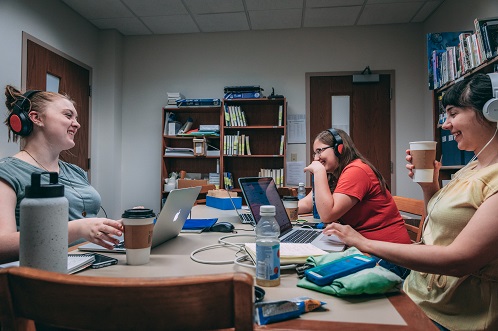
Erin Dorbin works with students on the Stories: YES Houston project. Photo credit: Kollective Photography
The Stories: YES Houston project had a profound impact on the students who participated, which Dorbin witnessed firsthand. “This program encouraged students to go out into their neighborhood and talk to members of the community, actually seeing how their lives connect to the place that they live,” she said. “Because of this program, I saw a higher level of confidence in students; they are now more connected to where they live, and they are more civically engaged. I want to thank SMIF for investing in these programs and providing these opportunities.”
For Dorbin, the benefits of rural life are evident. As a young, hardworking individual who previously struggled to find cost-effective housing, Dorbin now lives in a community she adores and works on various creative initiatives she has passion for, including leading the Crystal Creek Citizen-Artist Residency. She has also found that living in a small town has helped her move further along in her career because Houston County welcomes younger people and new ideas. “You can put your own personal touch into every part of your work and really grow as a young professional in small towns and in rural areas,” Dorbin said. She encourages those who are looking to make an impact in their community to consider living in southern Minnesota.
This story is part of our Love Where You Live story series showcasing why people love living and working in southern Minnesota. To learn more about the benefits of living and working in Greater Minnesota, check out the cost of living tool from the Center for Rural Policy and Development. To learn more about our Love Where You Live campaign, visit smifoundation.org/lovewhereyoulive.